What BIP-360 actually proposes
Updated September 2026
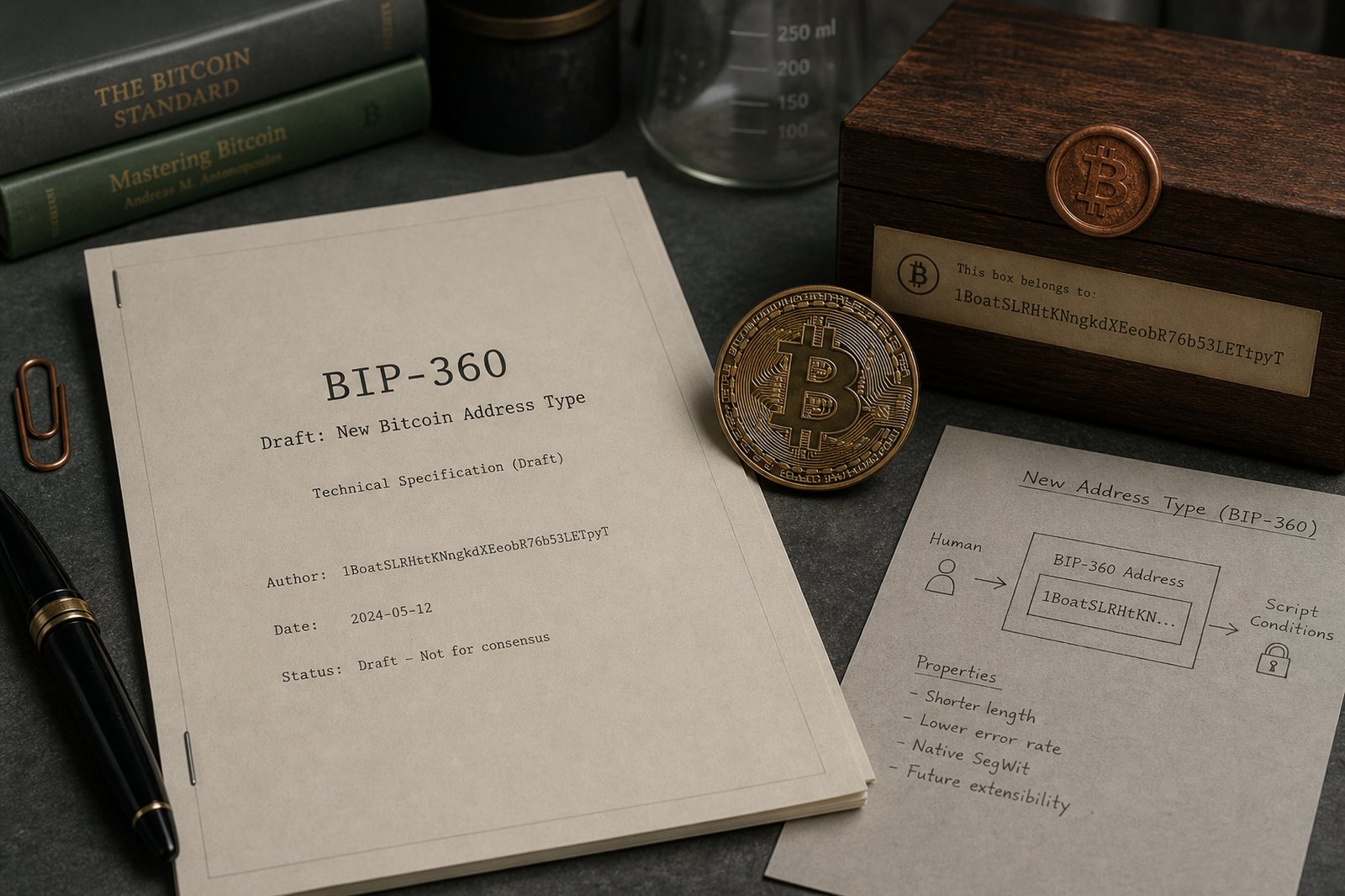
BIP-360 is a draft proposal for a new Bitcoin address format designed to resist attacks from a future quantum computer, and it has not been adopted by the network. It's still a proposal, not a rule Bitcoin runs on today.
If you've read the main explainer on quantum risk to Bitcoin, you already know the short version: nothing that exists right now can break Bitcoin's cryptography, but the people who maintain the protocol like to plan decades ahead. BIP-360 is one piece of that planning. This page goes a level deeper into what it actually proposes and why the fix isn't as simple as it might sound.
Why you can't just patch the old address types
Bitcoin's signatures depend on elliptic curve math over the secp256k1 curve. A quantum computer running Shor's algorithm could, in theory, take a public key and work backward to the private key that produced it. That's not a weakness you patch by making numbers bigger. It's a different category of problem than the one quantum computers pose to hash functions.
Hash-based security (the kind protecting an address before its first spend) only faces Grover's algorithm, which gives a quantum computer a quadratic speedup at best. You defend against that by using a longer hash output. Simple, and no redesign needed. Shor's algorithm is a different animal. It doesn't just speed up the attack, it solves the underlying discrete logarithm problem efficiently. There's no "use a bigger secp256k1 key" fix, because the whole curve becomes tractable, not just slower to break. The only real defense is switching to a signature scheme built on math that Shor's algorithm doesn't help with, which means a new address format, not a patched old one.
What BIP-360 actually proposes
BIP-360, titled Pay-to-Merkle-Root (P2MR), proposes a new output type that works almost like Taproot with one piece removed: the key path. A P2MR output commits only to the root of a script tree, uses SegWit version 2, and would give addresses starting with bc1z. With no internal key committed, no public key sits on the chain while the coins wait. The BIP says this resists long exposure attacks on keys already on the chain, and states that "P2MR does not, by itself, protect against short exposure quantum attacks", because today's script leaves still sign with secp256k1 and publish that key at spend time.
Post-quantum signatures are a separate layer. They would draw on the same family of algorithms NIST finalized as standards in 2024, things like ML-DSA (based on CRYSTALS-Dilithium) and SLH-DSA (based on SPHINCS+), or on Bitcoin-specific drafts such as SHRINCS. BIP-361 is a separate draft about migration: it would first stop new payments to vulnerable output types and later restrict legacy signatures. A draft exposure classification submitted in September 2026 labels P2MR "exposed on spend" for the same reason BIP-360 gives.
Beyond that, I'd rather be honest than precise: the exact scheme, the signature sizes, and the transition mechanics are still being argued over by contributors, and draft BIPs change shape as review continues. Post-quantum signatures also tend to be much larger than the ECDSA or Schnorr signatures Bitcoin uses now, which has real consequences for transaction fees measured in sats (worth a glance at the sats converter if you want a feel for how those unit costs stack up). None of that is locked in yet, and anyone telling you the final spec today is getting ahead of the process.
Why a new format is harder than it sounds
Adding a new address type is the easy part. Bitcoin has done it before: SegWit in 2017, Taproot in November 2021. The harder question is what happens to coins that never move to the new format, especially the ones that already have an exposed public key sitting on-chain.
| Address type | Prefix | Public key visible on-chain |
|---|---|---|
| P2PKH | starts with 1 | only after the first spend |
| P2SH | starts with 3 | only after the first spend |
| SegWit v0 (P2WPKH/P2WSH) | starts with bc1q | only after the first spend |
| Taproot (P2TR) | starts with bc1p | immediately, on receipt |
An estimated 5.4 million BTC, roughly a quarter of the 21 million total supply, already sits in addresses where the public key is exposed, mostly because those addresses were spent from at some point. About 1.1 million BTC of that is tied to Satoshi Nakamoto's early mining, untouched since around 2010. You can check where any specific address lands on that spectrum with the wallet checker, which looks at spend history and address type to show an exposure tier.
The genuinely uncomfortable part
Some proposals floated alongside BIP-360 go further than just offering a new address type. They'd eventually restrict spending from long-dormant, exposed addresses, most visibly the Satoshi-era coins, if the owner doesn't migrate within some window. That idea runs straight into one of Bitcoin's oldest norms: nobody gets to decide whose coins are allowed to move. Whether the community would actually adopt something like that, and how it would even be enforced without a central authority making the call, is unresolved. I'm not going to pretend there's consensus on it, because there isn't.
Where things actually stand
As of now, BIP-360 is a draft. It hasn't activated, there's no deployed code path using it on mainnet, and no fixed date for when or if it will. Estimates for when a quantum computer capable of threatening secp256k1 might exist range from several years to a decade or more, and honestly, nobody knows for certain. That uncertainty is exactly why the proposal is being worked through carefully rather than rushed. Ethereum and most other cryptocurrencies built on elliptic curve cryptography face a version of this same question, so Bitcoin isn't unusually exposed here, it's just the one with the most value and history riding on getting the transition right.
What isn't settled yet is the exact signature scheme, the finished address format, and the transition timeline, and I won't pretend those questions have answers before the BIP review process actually settles them. Nothing calling itself the final version of BIP-360 today is one.
Quick answers
- What is BIP-360?
- A draft proposal for quantum-resistant Bitcoin output types. It is not activated.
- Does it close already-open coins?
- Only if those coins are later moved into a new output type the network actually accepts.
- Should I wait for BIP-360 before doing anything?
- Nothing is required today. Read drafts as drafts.