Is Bitcoin safe from quantum computers?
Updated September 2026
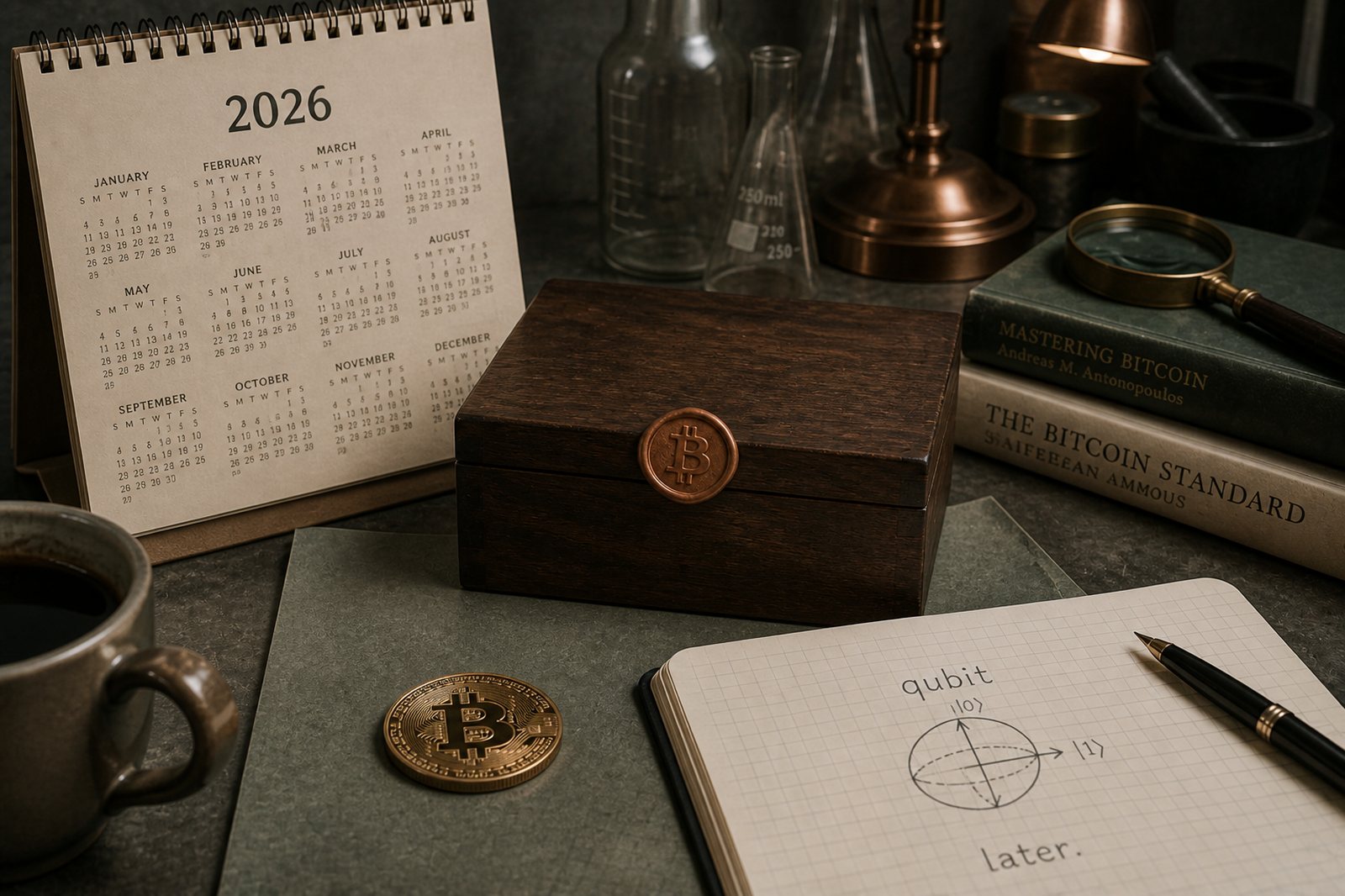
Yes, today. The cryptography Bitcoin relies on (elliptic curve signatures over secp256k1) has not been broken by any quantum computer that exists or is credibly expected to exist within the next several years. What changed in 2026 is that the timeline for when this stops being true got shorter than most people assumed, which is why the conversation got louder without anything actually breaking.
What actually happened this year
Two things moved the needle. A research paper in early 2026 significantly cut the estimated number of qubits needed to break the elliptic curve cryptography Bitcoin uses, roughly a twentyfold reduction from prior estimates. Separately, researchers demonstrated breaking a small, deliberately toy-scale elliptic curve key on real quantum hardware, proving the attack category works in principle at a tiny scale, not that any Bitcoin key is actually at risk today. Neither event breaks Bitcoin. Both events shortened how comfortable people feel about the runway.
The two address categories that matter
Not every bitcoin holding faces the same exposure. Addresses that have never spent (only received) keep their public key hidden behind a hash, which is a meaningfully harder target. Addresses that have spent at least once, or any Taproot address regardless of spend history, have their public key sitting in plain sight on the blockchain forever. Check which category your own address falls into. Roughly 5.4 million BTC, about a quarter of the total 21 million supply, currently sits in the exposed category, much of it simply from ordinary use over the years rather than carelessness.
The proposals: BIP-360 and BIP-361
Both are draft Bitcoin Improvement Proposals aimed at the same underlying goal: giving the network a quantum-resistant address format and a migration path toward it, without requiring a disruptive hard fork on a rushed timeline. The harder, more contentious question sitting next to the technical proposals is what happens to coins in exposed addresses that are inactive: most visibly the roughly 1.1 million BTC associated with Satoshi Nakamoto's early mining, untouched since 2010 or so. Some proposals in the wider debate include a mechanism to eventually freeze or restrict spending from long-dormant, publicly-exposed addresses if their owners don't migrate them within a defined window. This is genuinely controversial inside Bitcoin's community, since it touches the principle that no one gets to decide whose coins move and whose don't.
Who's working on this seriously
Beyond the core protocol proposals, dedicated projects track exposed addresses and quantum readiness as their whole focus, some with real funding behind them (one such project raised on the order of 26 million dollars specifically for quantum-migration tooling). That level of investment is itself a signal: enough serious people think the timeline is close enough to be worth building for now, not later.
What you can actually do about it
The one concrete, available-today mitigation is simple: don't reuse a spent address, and if you're holding a meaningful amount in an address that has already spent (or any Taproot address), moving it to a fresh, never-used address resets you to the harder-to-attack category. That's not a permanent fix, since any address becomes exposed again once you spend from it, but it's the actual lever you have right now, well before any final quantum-resistant standard is finalized and widely adopted.
This describes the technical debate as reported through mid-2026 as accurately as we can. It is not investment advice, not a security guarantee, and not a prediction about bitcoin's price. Treat any date estimate for a working cryptographically-relevant quantum computer as genuinely uncertain; serious estimates still range from several years to a decade or more.
Quick answers
- Is Bitcoin safe from quantum computers today?
- Yes. No existing machine can break secp256k1 in time to steal coins.
- What changed in 2026?
- Estimates of qubits needed dropped, and a toy-scale curve was broken on hardware. Neither event broke Bitcoin.
- What should I do?
- Know if your address is closed or open. Do not panic-move. Hygiene is optional and unhurried.