Why a cat, and why Schrödinger
Updated September 2026
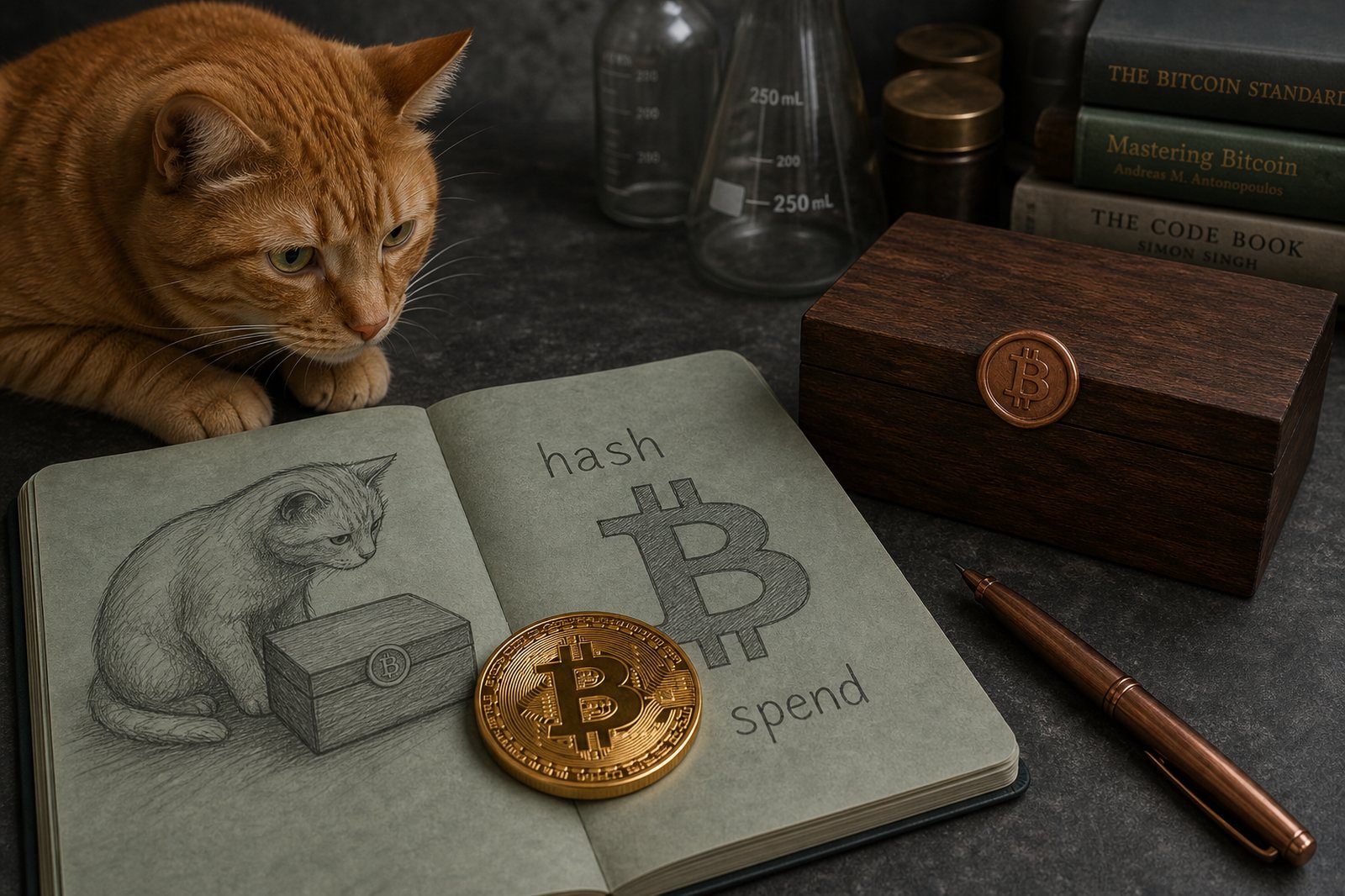
Most sites that pick a cat mascot picked it because cats do well on the internet, and that's a perfectly good reason on its own. If you assumed this one was chosen for the same reason, you're missing the part that actually matters: an unspent Bitcoin address really does sit in a state of not-yet-known, and that's structurally close to the exact thing Erwin Schrodinger was pointing at in 1935. It isn't just a pun. The mechanics line up in a way that most "quantum cat" branding never bothers to check.
what Schrodinger was actually arguing
Schrodinger's thought experiment gets remembered as "the cat is alive and dead at once," which is almost the opposite of what he meant. He proposed a sealed box containing a cat, a vial of poison, and a radioactive trigger with a fifty percent chance of firing. Taken literally, the physics of the day said that until someone opened the box and looked, the radioactive atom existed in a superposition of decayed and not decayed, and by extension so did the cat's fate. Schrodinger wasn't endorsing that conclusion. He was using it to show how strange it sounds once you scale quantum uncertainty up to something you can hold in your arms. It was an objection dressed up as an illustration.
the part that maps onto a Bitcoin address
Strip out the physics and keep the structure: a fact exists, but the public record doesn't contain enough information to state it, until a specific event exposes it. That's a fair description of how a Bitcoin public key behaves before you spend from an address.
The chain runs in three steps:
- a private key, a large random number, generates a public key through elliptic curve multiplication, a one-way operation
- that public key gets hashed and encoded into the address you actually hand out or receive coins at
- spending requires signing with the private key, which is the moment the public key itself gets published on chain
For P2PKH addresses (the ones starting with "1"), P2SH ("3"), and SegWit v0 ("bc1q"), what sits in the public record before a spend is only a hash of the public key, not the key itself. Nobody looking at the chain, including someone with a hypothetical quantum computer, can read the public key off an unspent address. The box stays closed until you open it by spending. The full explainer on whether Bitcoin is safe from quantum computers goes into why that distinction matters more than most coverage of the topic lets on.
Taproot addresses (the "bc1p" ones, active since November 2021) break the pattern on purpose: a P2TR address commits to the actual public key directly, so it's visible the moment coins arrive, not the moment they leave. The box is already open at delivery. That's a real design tradeoff Taproot made for other good reasons, and it's worth knowing which kind of address you're holding.
| Address type | What's visible before any spend | Box status |
|---|---|---|
| P2PKH ("1...") / P2SH ("3...") | Only a hash of the public key | Closed |
| SegWit v0 (bc1q...) | Only a hash of the public key | Closed |
| Taproot P2TR (bc1p...) | The public key itself, on receipt | Open on arrival |
where the metaphor should stop
Being precise about this matters, so here's the honest limit: nothing about an unspent address is quantum mechanically uncertain. It's a plain cryptographic secret sitting in ordinary classical math. The public key is a fixed, determined value the whole time, we just can't derive it from the hash with current techniques, and the hash reveals nothing about it either. That's a one-way function doing its job, not superposition. What genuinely resembles Schrodinger's setup is only the shape of the situation: a definite fact, screened from outside observation, until one specific event removes the screen. That's a narrower claim than "quantum cat," and it's the one that actually holds up.
It's also why the metaphor has some real teeth behind it. Roughly 5.4 million BTC, about a quarter of all bitcoin that will ever exist, already sits in addresses where the public key has been exposed by a prior spend, including an estimated 1.1 million BTC tied to Satoshi-era mining that's been dormant since around 2010. Those boxes have already been opened. Whether that matters today comes down to whether a quantum computer capable of breaking secp256k1 exists yet, and it doesn't, by any credible estimate. But "opened" versus "closed" is a real, checkable property of a real address, not a metaphor stretched past its use.
If you want to see which category your own address falls into rather than take any of this on faith, paste it into the Schrodinger's Wallet checker and let it read the chain directly.
Quick answers
- Why a cat?
- Schrödinger's sealed box is the shape of an unspent hash-based address: a fact screened until one event exposes it.
- Is the public key in superposition?
- No. It is a fixed number behind a hash. The metaphor stops at the shape, not the physics.
- Why Taproot breaks the picture?
- Taproot puts the key on the box at delivery. There is no closed state after receipt.