Taproot opens the box on arrival
Updated September 2026
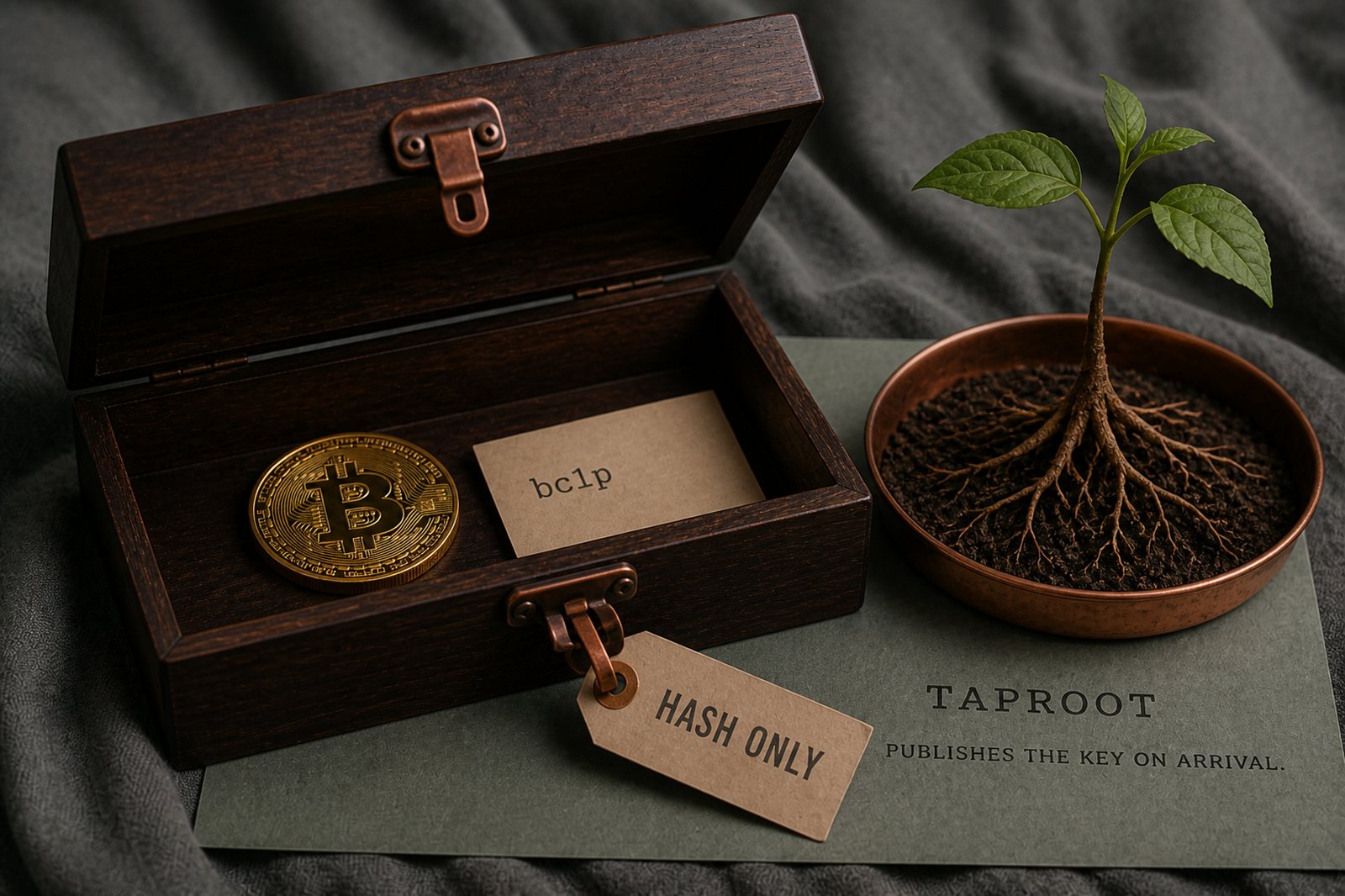
Most people assume newer means safer. Taproot activated in November 2021, it's the most recent major upgrade to how bitcoin addresses work, and it brought real improvements: smaller transactions, more privacy, more flexible scripting. So the natural guess is that a Taproot address, the one starting with bc1p, is also the more quantum-resistant option. It's actually the reverse. A Taproot address exposes its public key the moment it receives funds, before it ever sends a single sat, which puts it in a more exposed position against a future quantum attack than the older formats it was built to improve on.
What "exposed" actually means here
A bitcoin private key is a large random number. The public key is derived from it through elliptic curve multiplication, a calculation that's easy to run forward and, with today's computers, infeasible to reverse. A bitcoin address is usually a hashed, encoded version of that public key, not the key itself. That distinction matters because the specific quantum threat to bitcoin, Shor's algorithm, targets the discrete logarithm problem behind elliptic curve keys. It doesn't do anything useful against a plain hash. So as long as your public key stays hidden behind a hash, there's simply nothing for that algorithm to work on yet.
Older address formats take advantage of that. P2PKH addresses (starting with "1"), P2SH ("3"), and SegWit v0 P2WPKH or P2WSH addresses ("bc1q") only reveal the actual public key on-chain once you spend from them. Before that first spend, an outside observer sees only a hash. Grover's algorithm is the weaker quantum threat that applies to hashes and symmetric crypto generally, and it's handled with larger output sizes, not a redesign. So an unspent address in one of these formats sits behind two layers: a hash Grover's algorithm barely dents, and a public key that hasn't even been published yet.
The tradeoff Taproot made on purpose
Taproot (P2TR) doesn't work that way, and this isn't an oversight, it's the whole point of the design. A Taproot output commits to an actual public key directly, so the key is sitting there in the open from the moment coins arrive, regardless of whether you've ever spent from that address. That directness is what makes Taproot's other benefits possible. Simple payments and complex script conditions both resolve down to the same compact key-shaped output, which is why a single-signer wallet and an elaborate multisig arrangement can look identical on-chain. That's a genuine privacy win, and it's also why Taproot transactions tend to be smaller and cheaper to verify, and why more expressive smart contract logic became practical without bloating every transaction that uses it. You can't get "the address is just a key" and "the key stays hidden until spend" at the same time. Taproot chose the key.
None of this was a secret trade at launch. It was understood as an engineering decision made for a world where the practical quantum threat was, and still is, distant. The efficiency and privacy gains were worth locking in now, on the working assumption that a real address-format response to quantum risk would arrive with time to spare.
| Address type | Common prefix | When the public key becomes visible |
|---|---|---|
| P2PKH | 1 | Only after the first spend |
| P2SH | 3 | Typically only after the first spend |
| SegWit v0 (P2WPKH / P2WSH) | bc1q | Only after the first spend |
| Taproot (P2TR) | bc1p | Immediately, on receiving funds |
What it means if you've already moved funds into a Taproot wallet
First, some perspective: no quantum computer that exists today, or that's credibly expected within the next few years, can act on an exposed public key fast enough to threaten a real address. Serious estimates for when a cryptographically-relevant quantum computer might exist range from several years to a decade or more, and that range is genuinely uncertain rather than a date anyone can pin down. The broader explainer on quantum risk covers what changed in 2026 and why the conversation got louder without anything actually breaking.
Second, the mitigation that works for hash-based address types, moving funds to a fresh, never-used address to reset exposure, doesn't fully apply once you're in Taproot. Because the key is exposed on receipt no matter what, moving coins from one Taproot address to another new one just creates a second exposed address. It doesn't buy back the hidden-key protection an unspent P2WPKH address still has. That's not a reason to panic, since today's exposure is theoretical either way, but it's worth understanding rather than assuming you've quietly reset something you haven't.
If you want to see where a specific address actually stands, rather than guess from the prefix alone, the wallet checker looks up the real spend history for any address and tells you which exposure tier it falls into. And if you're consolidating several older, already-exposed addresses into one and want to sanity-check the total before signing anything, the sats converter handles the plain unit arithmetic, no price data involved.
Roughly 5.4 million BTC, about a quarter of the 21 million total supply, already sits in exposed addresses today, mostly from ordinary spending over the years rather than carelessness. Taproot adoption adds to that pool by default, immediately, rather than gradually through use. BIP-360 and BIP-361 are the draft proposals aimed at eventually giving bitcoin a quantum-resistant address format and a migration path, but they're still drafts, not activated rules, and the details are still being worked out in public.
Settled versus still open
What's settled: Taproot's design commits to a visible public key at the moment of receipt, that's a property of how the output script works, not a rumor or a bug report waiting to be patched. It was a known tradeoff for real gains in privacy, efficiency, and script flexibility, and it hasn't changed since November 2021. What's genuinely open: how many years remain before hardware exists that can act on that exposure, whether BIP-360, BIP-361, or something else entirely becomes the eventual standard, and how contentious questions around long-dormant exposed coins get resolved. None of that uncertainty changes the first part. The exposure is a fact you can check today. The timeline for when it starts to matter is not one anyone can currently give you with confidence.
Quick answers
- Why is Taproot open on arrival?
- A P2TR address commits to an x-only public key. The key is visible when coins arrive, not only when they leave.
- Is that a Taproot bug?
- No. It is a tradeoff for other benefits. Know it if your goal is a closed box.
- Should I stop using bc1p?
- Not for today's attackers. Use bc1q if you specifically want the hash-until-spend property.